

You built the website. You listed the properties, and you waited for the inquiries to come in. However, the phone stays quiet, the inbox stays empty, and your competition keeps closing deals you never heard about. Sound familiar?
The problem is rarely your listings. Most of the time, it is visibility. If your real estate website does not appear on the first page of Google when buyers and sellers search for an agent or a property, you might as well not have a website at all. The good news is that this is a fixable problem. Understanding why your site is invisible is the first step toward changing that.
Why Google Visibility Matters More Than You Think
Most home buyers and sellers start their search online, with studies consistently showing that over 90 percent of property searches begin on a search engine. Of those searches, roughly 75 percent of users never scroll past the first page of results. If your website ranks on page two or beyond, the vast majority of potential clients will never find you—which is why partnering with a proven link building service provider in real estate can make all the difference in boosting your search visibility.
Your competitors who do appear on page one are capturing that traffic, making SEO the most critical real estate website fix to boost buyer inquiries. They are getting the calls, booking the consultations, and winning the listings—proving that ranking well on Google is not a vanity metric, but a direct driver of how many leads you generate each month.
The encouraging reality is that most real estate websites have fixable issues holding them back. Poor keyword choices, slow load times, weak content, and missing local signals are the most common culprits. Each one can be addressed with a clear plan and consistent effort.
The Most Common Reasons Your Real Estate Website Is Not Ranking
Understanding what is going wrong is essential before you can fix it. Here are the most frequent issues that make real estate websites invisible on Google.
You Are Targeting the Wrong Keywords
Many agents make the mistake of optimizing their website for broad, highly competitive terms. Phrases like “real estate agent” or “homes for sale” attract enormous competition from national portals like Zillow, Realtor.com, and Redfin. These platforms have millions of pages and decades of authority. Competing with them on generic terms is nearly impossible for an individual agent or small brokerage.
However, local and specific keywords are a different story. Phrases like “homes for sale in Naperville Illinois” or “first-time buyer agent in Austin Texas” are far more targeted. They attract buyers and sellers who are ready to act. Additionally, they carry far less competition, which makes ranking achievable.
The fix is simple in principle: shift your keyword focus to local, neighborhood-specific, and intent-driven terms. Build pages and content around those phrases rather than chasing broad national terms.
Your Website Loads Too Slowly
Speed is a ranking factor. Google measures how quickly your pages load and uses that data to determine how high you appear in search results. A real estate website that takes more than three seconds to load will rank lower and lose visitors before they even see your listings.
Large, uncompressed property images are the most common cause of slow load times on real estate sites. High-resolution photos are important for showcasing homes, but they need to be properly sized for the web before upload. Additionally, outdated website themes, too many plugins, and poor hosting plans all contribute to sluggish performance.
You can test your website speed for free using Google’s PageSpeed Insights tool. It provides a score and a clear list of what to fix. Addressing even the top two or three issues can produce significant improvements in both speed and ranking.
You Have Thin or Duplicate Content
Content is one of Google’s primary ranking signals. A website with only a homepage, a contact page, and a property search widget gives Google almost nothing to work with. There is no content to analyze, no keywords to match, and no reason to rank the site above competitors who publish regularly.
Duplicate content is an equally serious issue. Many agents use the same bio, service descriptions, and neighborhood text copied from their brokerage’s main site. Google sees this as duplicated material and ranks neither version highly. Your website needs original, useful content that appears nowhere else on the internet.
You Are Missing Local SEO Signals
Real estate is inherently local. Buyers search for homes in specific neighborhoods, zip codes, and school districts. Sellers want an agent who knows their street, not just their city. Therefore, your website needs to send strong local signals to Google.
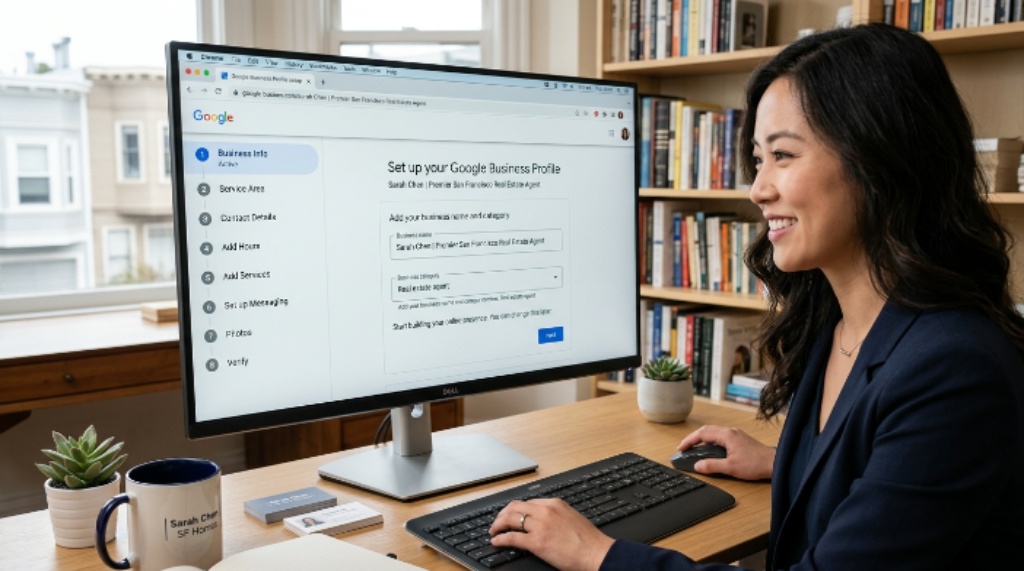
The most important local signal is your Google Business Profile. If you have not claimed and fully completed your profile, you are missing one of the most powerful free tools available. A complete profile with accurate contact information, updated photos, service areas, and regular posts directly improves your visibility in local search results.
Additionally, your website should include your full address, local phone number, and service areas on every page. Embedding a Google Map, earning local citations from directories, and getting listed in local chamber of commerce websites all strengthen your local authority.

What a Well-Optimized Real Estate Website Looks Like
To understand where your site falls short, it helps to see what a well-optimized real estate website includes. The table below summarizes the key elements and their purpose.
| Website Element | Purpose | Impact on Ranking |
| Local keyword pages | Target city and neighborhood searches | High |
| Google Business Profile | Appear in local map pack results | Very High |
| Fast load speed | Improve user experience and ranking signal | High |
| Original blog content | Build topical authority and drive traffic | Medium to High |
| Mobile-friendly design | Serve the majority of users on phones | Very High |
| Schema markup | Help Google understand your pages | Medium |
| Internal linking | Distribute authority across your site | Medium |
| Client reviews and testimonials | Build trust and support local rankings | High |
| Neighborhood guide pages | Capture hyperlocal search traffic | High |
| Backlinks from local sites | Signal authority to Google | Very High |
Most real estate websites score well on design but fall short on content, local signals, and technical performance. Addressing all three areas together produces the strongest results.
How Neighborhood Guide Pages Unlock Hidden Traffic
One of the most underused strategies in real estate content marketing is the neighborhood guide page. This is a dedicated page on your website that covers a specific area in depth. It might include information about local schools, average home prices, parks, restaurants, commute times, and what makes the neighborhood a great place to live.
These pages work for two reasons. First, they match exactly what buyers type into Google when they are researching a move. Second, they position you as a genuine local expert rather than just another agent with a property search widget. A buyer who spends ten minutes reading your guide on a neighborhood is far more likely to contact you than someone who bounced off a generic homepage.
Aim to create one neighborhood guide for every area you serve. Each guide should be at least 600 words, include original observations, and answer the questions real buyers actually ask. Over time, a library of these pages builds significant local search authority.
The Role of Reviews in Real Estate Search Rankings
Online reviews do more than build social proof. They directly influence where you appear in local search results. Google uses the quantity, recency, and sentiment of your reviews as ranking signals, particularly for your Google Business Profile listing.
Agents with 50 or more recent positive reviews consistently outrank agents with fewer reviews, even when other factors are similar. Therefore, collecting reviews should be a routine part of your business process, not an afterthought.
The most effective approach is simple. After closing a transaction, send your client a direct link to your Google review page and ask them to share their experience. Most satisfied clients are happy to help. A short, personal request works far better than a generic email template.
Additionally, responding to every review — positive or negative — signals to Google that your profile is active and well-managed. It also shows potential clients that you are attentive and professional.
Mobile Optimization Is No Longer Optional
More than 60 percent of all real estate searches now happen on a smartphone. Google switched to mobile-first indexing several years ago, which means it primarily uses the mobile version of your website to determine your ranking.
A site that looks great on a desktop but breaks on a phone, loads slowly on mobile data, or has buttons too small to tap will rank lower and frustrate the visitors it does attract. Testing your website on multiple devices and screen sizes is a basic but essential habit.
Your mobile site should load in under three seconds, display listings clearly without horizontal scrolling, and make it easy to call or email you with a single tap. These small details have a direct impact on both ranking and conversion.
Backlinks: Why Other Websites Need to Talk About You
A backlink is a link from another website pointing to yours. Google treats these as votes of confidence. The more credible websites that link to you, the more authority your site gains, and the higher it ranks.
For real estate agents, building backlinks does not require complicated outreach campaigns. Practical and effective sources include:
- Local business directories and chamber of commerce listings
- Guest posts on local community blogs or neighborhood news sites
- Being quoted as a local real estate expert in regional publications
- Sponsoring local events that publish a list of sponsors online
- Partnering with local mortgage brokers, contractors, or attorneys who link to your site
Each backlink from a credible local source strengthens your domain authority and improves your position in search results over time.
Conclusion
An invisible real estate website is a lead generation problem with a solvable cause. Targeting the wrong keywords, slow load speeds, thin content, missing local SEO signals, and a lack of backlinks are the primary reasons most real estate websites fail to rank on Google. Fixing these issues requires consistent effort, but none of them demand a complete website rebuild. Start with your Google Business Profile, add neighborhood guide pages, improve your site speed, and build a habit of collecting client reviews. Each improvement compounds over time. Agents who invest in their search visibility today are the ones capturing leads that others never see. Your website has the potential to become your most productive lead generation tool. It just needs to be visible first.
Frequently Asked Questions
How long does it take for a real estate website to rank on Google?
Most real estate websites begin to see meaningful improvements in rankings within three to six months of consistent SEO effort. Competitive markets may take longer. Local and neighborhood-specific keywords tend to rank faster than broad terms. Consistent content publication, technical fixes, and review collection all accelerate the process.
Do I need to blog regularly to rank on Google?
Regular content helps significantly, but quality matters more than frequency. Publishing one well-researched neighborhood guide or market update per month is more effective than posting thin content every week. Google rewards content that genuinely answers the questions buyers and sellers are searching for.
What is the most important thing I can do today to improve my real estate website’s visibility?
Claim and fully complete your Google Business Profile if you have not done so already. Add accurate contact information, your service areas, business hours, photos, and a clear description of your services. This single step often produces noticeable improvements in local search visibility within weeks.
Should I hire an SEO agency to fix my real estate website?
It depends on your budget and how much time you can invest yourself. Many of the most impactful fixes, such as completing your Google Business Profile, improving page speed, and publishing neighborhood guides, can be done without outside help. An agency makes sense if you want faster results or lack the time to manage ongoing content and technical updates.
Why is my competitor ranking higher than me even though my website looks better?
Design and ranking are separate things. A visually impressive website can rank poorly if it lacks content, local SEO signals, backlinks, and technical optimization. Your competitor likely has more original content, a stronger Google Business Profile, more client reviews, and more websites linking to theirs. Addressing those gaps will close the ranking difference over time.

Leave a Reply